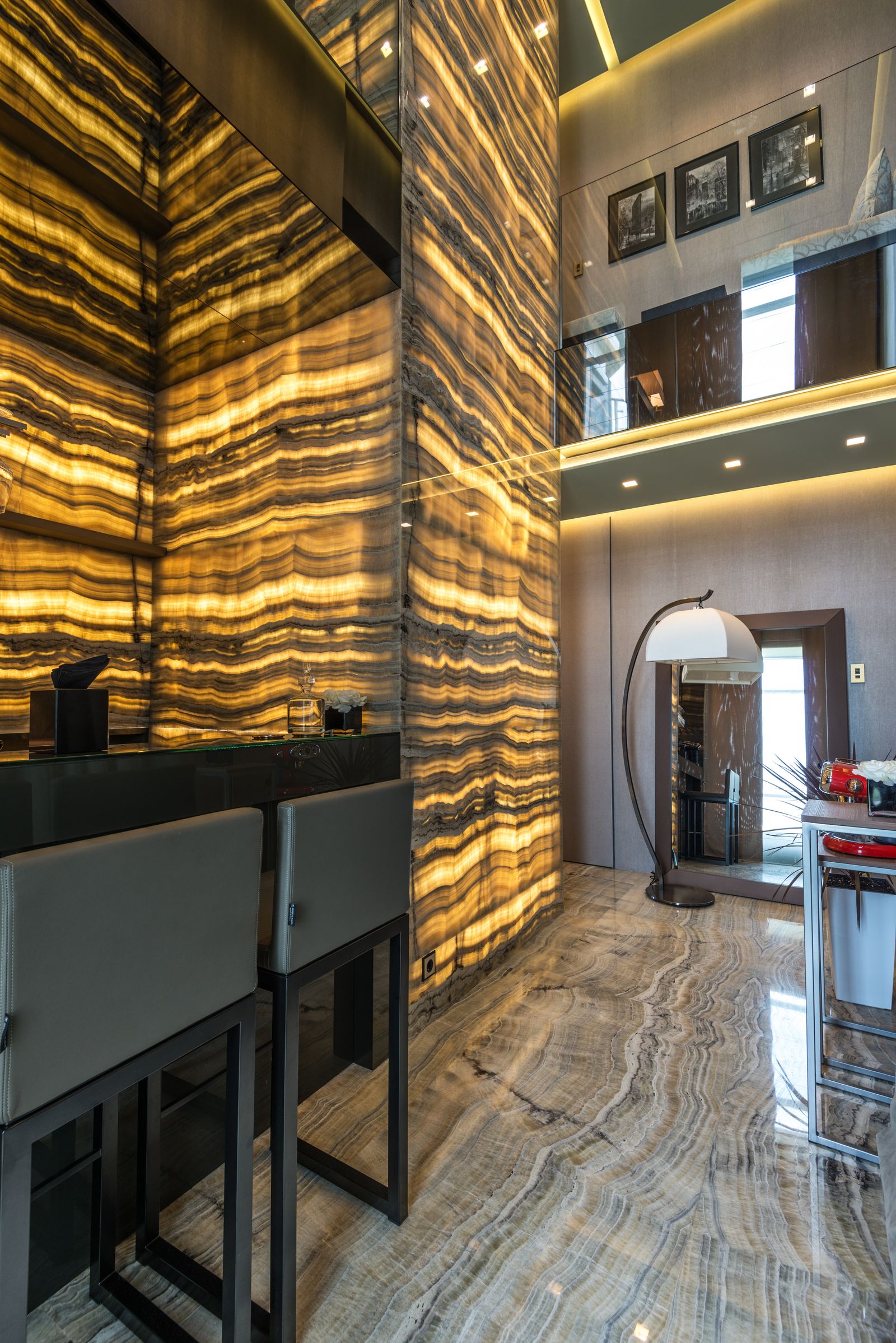
Inlaid stone floors have a long history in the region, from the geometric patterns of Islamic architecture to the grand entrance halls of today’s Emirati villas. What has changed is the tooling. Modern waterjet cutting lets us cut interlocking pieces of different marbles to fractions of a millimetre, so complex marble inlay designs that once took months of hand-carving can now be cut, assembled and installed in a few weeks.
Where marble inlay works best
- Villa entrance halls: a medallion centred under the chandelier is the classic placement and the first thing guests see.
- Majlis: a border or geometric field that frames the seating area and defines the room.
- Staircase landings: a smaller medallion or star pattern that links upper and lower floors — see our marble staircase design guide.
- Hotel and tower lobbies: large-scale patterns, logos or compass motifs.
- Corridors: repeating borders or runner patterns that guide the eye.
How waterjet marble inlay is made
- Design. The pattern is drawn in CAD, scaled to the room and positioned against the floor layout, lighting and furniture plan.
- Stone selection. Each colour in the design is assigned a stone, and we reserve slabs from a single block for each so the tones stay consistent.
- Waterjet cutting. An abrasive waterjet, a stream of water and garnet at very high pressure, cuts each piece cold, without heat cracks or chipping. Tight curves and sharp points that a saw could never achieve are routine. Read more about our waterjet cutting service.
- Dry assembly. The pieces are fitted together on a flat table in the workshop, checked for fit and colour, then bonded to a mesh or resin backing in sections.
- Installation. Sections are laid into the floor flush with the surrounding marble.
- Grinding and polishing. The whole floor is ground flat and polished together, so the medallion and field become one continuous surface.
Choosing stones for contrast
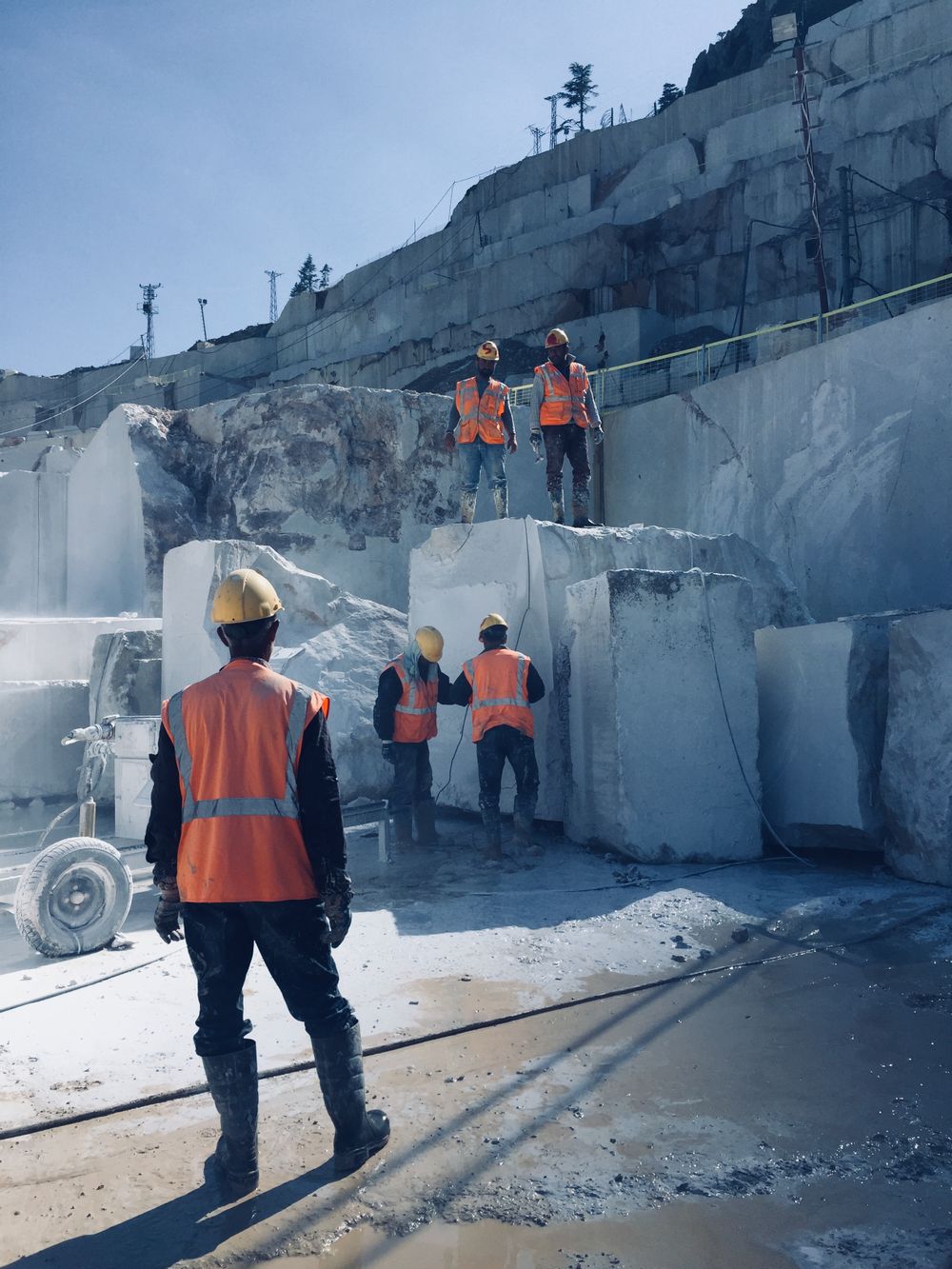
A good medallion depends on contrast in tone, not just colour. Two marbles that look different in the slab yard can blur together on the floor once polished. These combinations work reliably:
| Role | Common stones | Effect |
|---|---|---|
| Field (background) | Crema Marfil, Botticino, Thassos | Calm base that lets the pattern read |
| Warm contrast | Light & Dark Emperador | Rich, traditional brown tones |
| Lines & outlines | Nero Marquina, Absolute Black | Crisp definition |
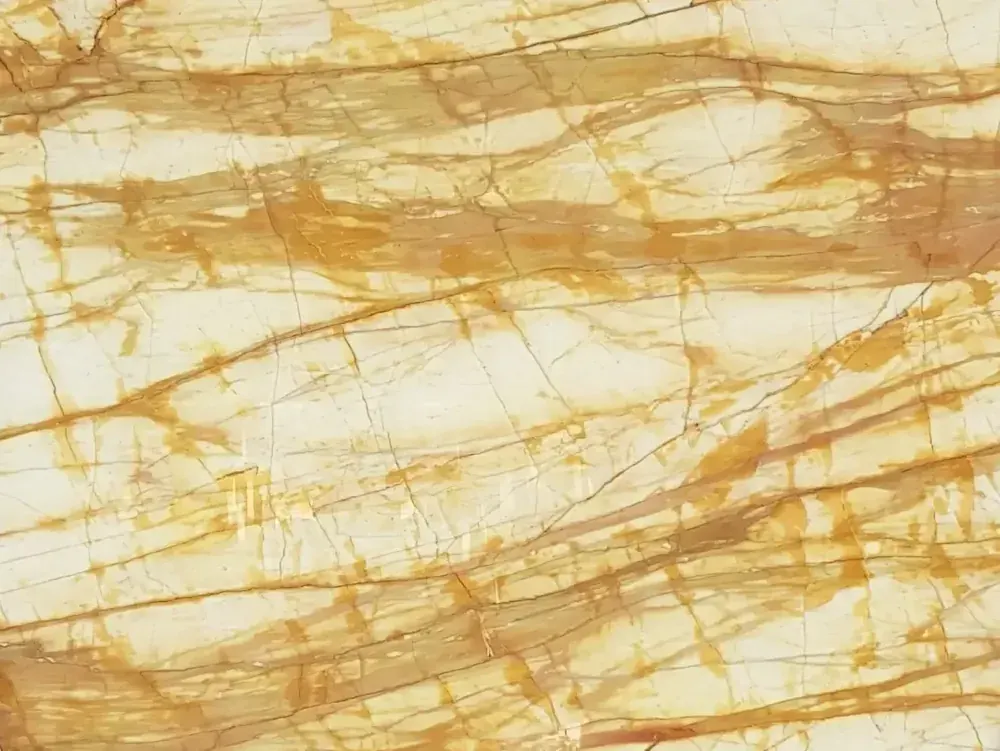
| Gold accents | Giallo Siena, Golden Emperador | Warmth and richness |
| Highlights | Statuario, Thassos, onyx | Brightness and depth |
| Colour accents | Verde Alpi, Rosso Levanto, semi-precious stone | Strong colour in small amounts |
Match hardness, not just colour
Very soft stones set beside very hard ones wear at different rates and can leave the softer pieces slightly lower over time. We pair marbles of similar hardness and avoid using onyx in heavy-traffic zones.
Patterns that stay timeless
- Geometric Islamic patterns — eight-point stars and interlacing grids feel at home in a majlis and never date.
- Simple compass or rosette medallions — two or three stones and strong geometry age better than busy floral designs.
- Borders — a narrow border of contrasting marble around the edge of a room is the most affordable way to add detail.
- Scale to the room — in an entrance, the medallion should usually be about one-third of the room’s shorter dimension, centred under the light fitting.
Inlay is not only for floors. The same technique works for feature walls, as on the crema marble walls we installed for the Ministry of Foreign Affairs at Festival Tower, and for tabletops and vanity tops.
Cost and lead time
Price depends on size, the number of stones and how fine the detail is. As an indicative guide in the UAE, a simple two- or three-stone medallion of about 1.2 metres starts in the low thousands of dirhams, and large, multi-stone designs can run well into five figures. Borders are usually priced per linear metre.
Once the design is approved, cutting and dry assembly typically take one to three weeks, and installation one to two days. Plan the medallion at the same time as the main floor so the stones are reserved together and the whole area is polished in one pass — our villa marble flooring guide covers the layout side.
Start with a sketch
Send us a photo, a reference image or a rough sketch with the room dimensions and we will prepare a CAD design with stone options and a price. Request a design proposal.
Frequently asked questions
How much does a marble medallion cost in the UAE?
A simple two- or three-colour medallion of around 1.2 metres in diameter typically starts in the low thousands of dirhams, while large, multi-stone designs with fine detail can run well into five figures. Price depends on size, number of stones, the fineness of the pattern and whether semi-precious stones are included.
How long does it take to make a waterjet marble inlay?
Once the design is approved, cutting and dry-assembly of a standard medallion usually takes one to three weeks at our Sharjah workshop, depending on complexity and stone availability. Installation is often completed in one to two days.
Which marbles are used for inlay work?
Common combinations include Crema Marfil or Botticino for the field, Dark and Light Emperador for warm contrast, Nero Marquina for black lines, Giallo Siena for gold tones, and Thassos or Statuario for bright whites. Onyx and semi-precious stones are added for accents.
Can a medallion be added to an existing marble floor?
Yes. We can cut out a section of an existing floor and set a new medallion into it, then grind and polish the whole area so the transition is flush. Matching the existing stone is the main challenge, so we check stock before quoting.