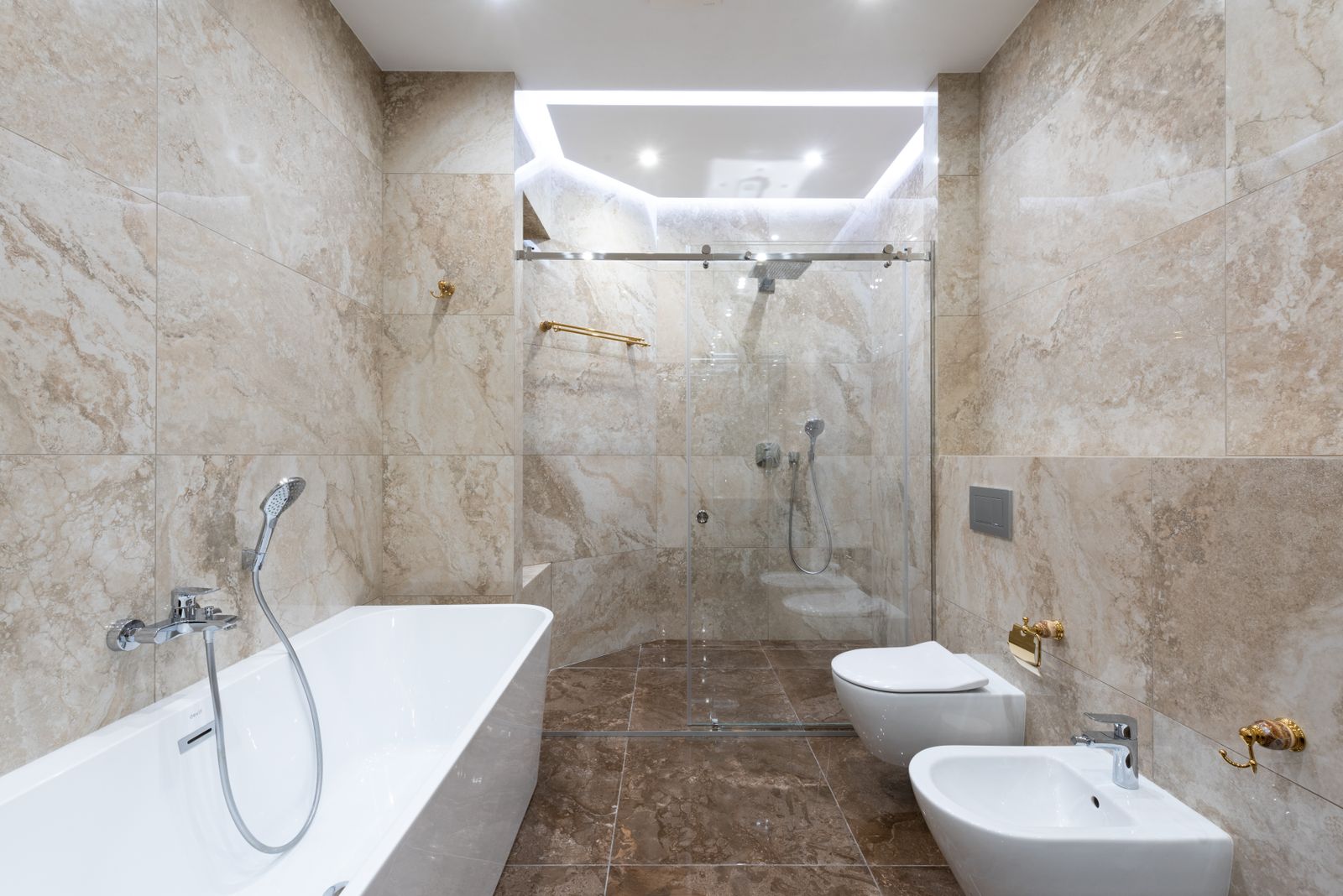
Every stone we install leaves with a care sheet, and the first line on it is the same: the enemy is not water, it is what the water leaves behind. This article is the longer version of that conversation.
What a sealer actually does
An impregnating sealer is not a coating. It soaks into the pore structure of the stone and lines those pores with a water and oil repellent compound, leaving the surface looking and feeling unchanged. It buys you time: a spill that would have soaked in within seconds now sits as a bead for several minutes while you wipe it away.
What it does not do is stop etching. If an acidic liquid touches polished marble, it dissolves the surface chemically. A sealer sits below that surface and cannot help. This distinction catches out almost everybody, so it is worth repeating: sealers prevent stains, not etch marks.
The water test
Drip a tablespoon of water onto the stone in three places and wait four minutes. If it still beads, your sealer is working. If the stone darkens where the water sat, it is time to re-seal. The darkening fades as it dries — it is not damage, it is a diagnosis.
Why the Gulf is a harder environment
Three local factors shorten sealer life compared with a temperate climate.
Hard water. Mains supply across most of the UAE carries a high dissolved mineral load. Every splash that evaporates leaves calcium and magnesium behind as a chalky ring. That ring tempts people towards acidic descalers, which then etch the stone. A sealed, quickly wiped surface never gets to that point.
Coastal salt and humidity. In Sharjah, Dubai and along the whole coastal strip, airborne salt settles on exterior stone and on any interior surface near an open door. Salt crystallisation inside the pores physically pushes at the stone from within, a process that damages sealers and, over years, the surface itself.
Thermal cycling. An exterior terrace can move from 48°C in the afternoon to 30°C overnight. An interior floor sits under air conditioning at 22°C with a warm, humid layer above it every time a door opens. Repeated expansion and contraction breaks down sealer films faster than a stable climate would.
Choosing the right sealer
- Solvent-based impregnators penetrate deepest and last longest. Our default for dense marble, granite and quartzite worktops. They need ventilation during application.
- Water-based impregnators are lower odour and fine for interior floors and walls, with a shorter service life.
- Enhancing sealers deepen colour permanently, which looks superb on honed dark stone and cannot be undone easily. Test on an offcut first, always.
- Topical coatings and waxes sit on the surface. We avoid them on floors: they scratch, they yellow in UV and they trap moisture in the stone.
For porous travertine and limestone, we normally apply a first coat before installation and a second after grouting, because grout haze removal is itself a risk to unsealed stone.
How to apply it properly
- Clean and dry completely. Any residue is sealed in. Allow a minimum of 24 hours after wet cleaning, longer in humid months.
- Apply generously in small sections with a lint-free pad, keeping the surface wet with sealer for the dwell time on the label — usually 5 to 15 minutes.
- Watch for dry patches and top them up. Porous areas drink more.
- Buff off all residue before it dries. Sealer left to cure on the surface leaves a hazy, streaky film that has to be stripped.
- Cure before use. Light use after 6 hours, water exposure after 48 to 72 hours.
Do this in the cooler part of the day. On a 45°C afternoon the sealer flashes off before it penetrates, and you end up with a surface film instead of protection.
A realistic maintenance schedule
| Location | Re-seal interval | Notes |
|---|---|---|
| Kitchen worktop, marble | 9–12 months | Test around the sink and hob first — they fail earliest |
| Kitchen worktop, granite | 18–36 months | Dark granites often need less |
| Bathroom walls & floors | 12–18 months | Squeegee after showering; it doubles sealer life |
| Interior floors | 2–3 years | Re-seal traffic lanes more often than the room |
| External terrace, coastal | 12 months | Rinse salt off with fresh water monthly |
| Pool surround | 12 months | Use a chlorine-tolerant impregnator |
Five mistakes we see every month
- Acidic bathroom cleaners on marble. Anything marketed as a limescale or lime-and-rust remover will etch calcite stone on contact. Use pH-neutral stone cleaner, nothing else.
- Vinegar and lemon as a “natural” cleaner. Natural, and among the most destructive things you can put on marble.
- Steam mops on stone floors. Forced hot moisture drives past the sealer and can lift adhesive over time.
- Leaving hard-water splashes to dry. Thirty seconds with a cloth prevents the scale ring that leads to the descaler that causes the etch.
- Sealing dirty stone. Whatever is on the surface when you seal is locked in underneath. Clean, dry, then seal.
Our aftercare promise
Every Artizee installation is sealed at handover and we return free of charge at six months to test the seal, check the joints and re-apply where needed. Hotels, offices and retail clients can put that on an annual contract.
If your stone has already been etched or stained, it is very rarely finished. Diamond honing and re-polishing removes a fraction of a millimetre and brings the surface back. Send us a photograph and we will tell you honestly whether it needs a visit or just a better cleaner.