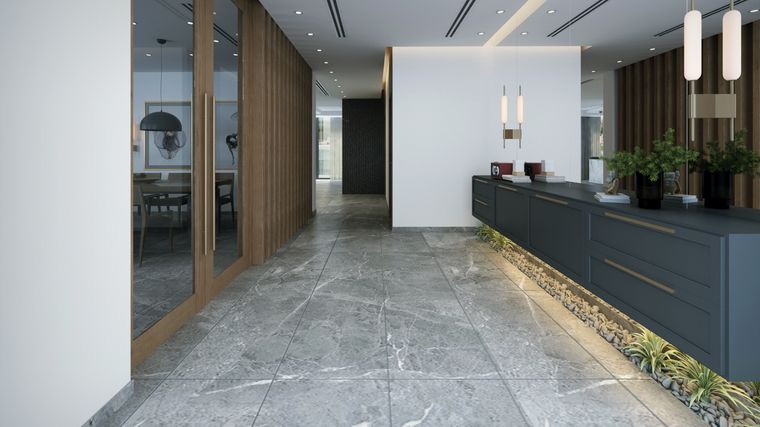
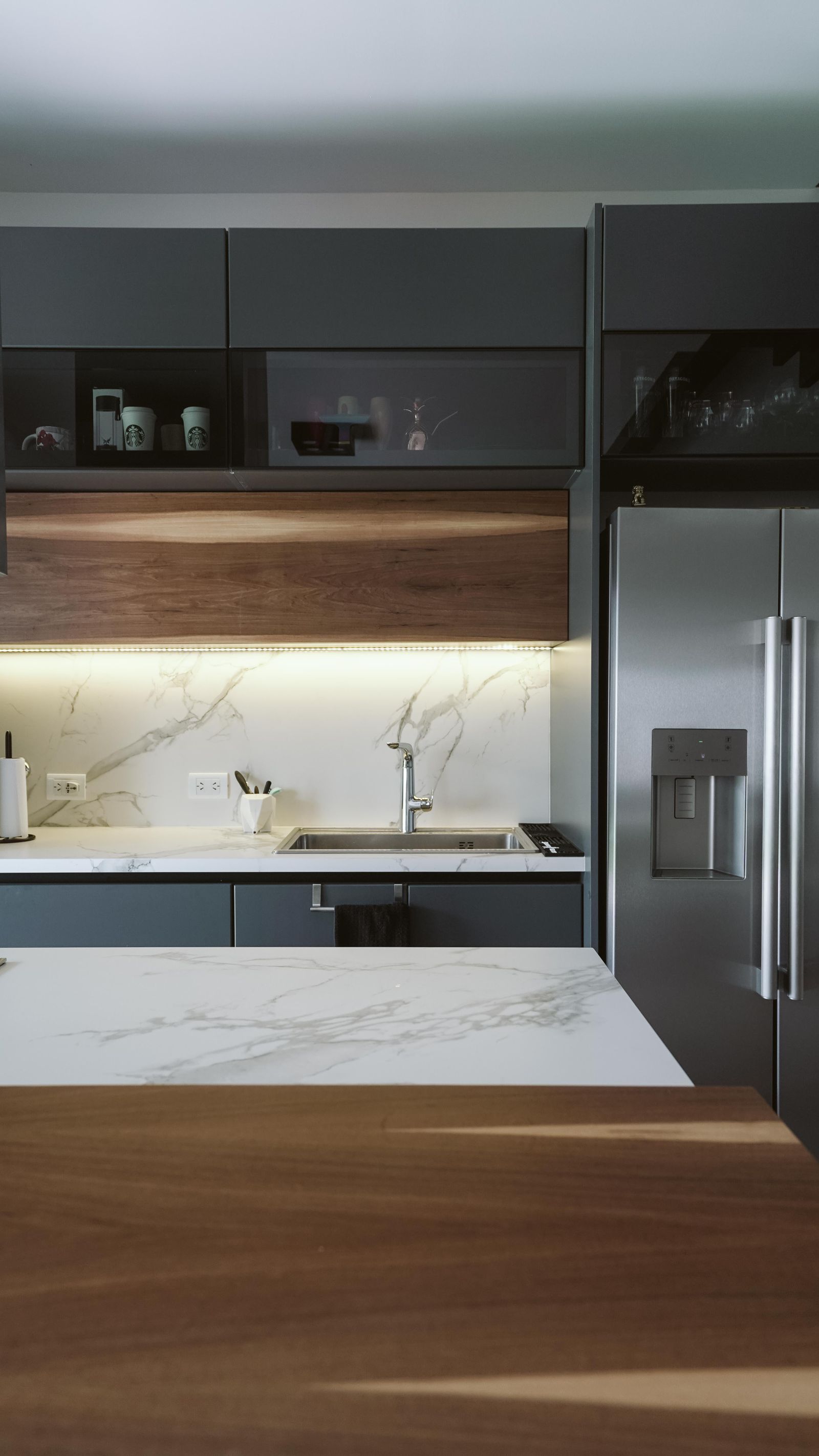
Both are manufactured surfaces sold in large slabs with marble-look veining. The difference sits in one word: resin. Engineered quartz has it, sintered stone does not, and almost every practical distinction follows from that.
How each one is made
Engineered quartz is roughly 90–93 per cent crushed natural quartz mixed with polyester resin and pigment, vibro-compacted under vacuum and cured at moderate temperature. The resin is the glue that holds everything together.
Sintered stone is mineral powder — feldspar, silica, clays and oxides — pressed at very high pressure and fired at around 1200°C. The particles fuse to one another. There is no binder at all; it is closer to a very dense porcelain than to a composite.
UV stability and outdoor use
This is the decisive difference in the Gulf. The polyester resin in engineered quartz degrades under ultraviolet light. In UAE sun, an outdoor quartz worktop will yellow and can develop surface crazing, often within two summers. Virtually every quartz manufacturer voids its warranty for direct outdoor exposure, and they are right to.
Sintered stone has nothing to degrade. It is used on ventilated facades that face the sun for thirty years, so a barbecue counter is a mild application by comparison.
The one-line rule
If sunlight reaches the surface at any point in the day, specify sintered stone or granite. Quartz belongs indoors, and even then not under an unshaded window.
Heat, scratching and staining
| Property | Engineered quartz | Sintered stone |
|---|---|---|
| UV stability | Poor — indoor only | Excellent |
| Heat tolerance | Marks above ~150°C | Direct hot pans accepted |
| Scratch resistance | Very good | Outstanding |
| Stain resistance | Excellent, non-porous | Excellent, non-porous |
| Acid resistance | Very good | Outstanding |
| Impact resistance | Good | Good, but thin sheets are brittle before install |
| Sealing required | No | No |
| Repairable on site | Chips can be filled | Difficult — colour runs through only on some products |
One nuance worth knowing: on many sintered slabs the decorative pattern is a printed layer under a transparent body, so a deep chip on an edge can expose a paler core. Full-body sintered products avoid this and cost more. Ask which you are being quoted.
Format, thickness and joints
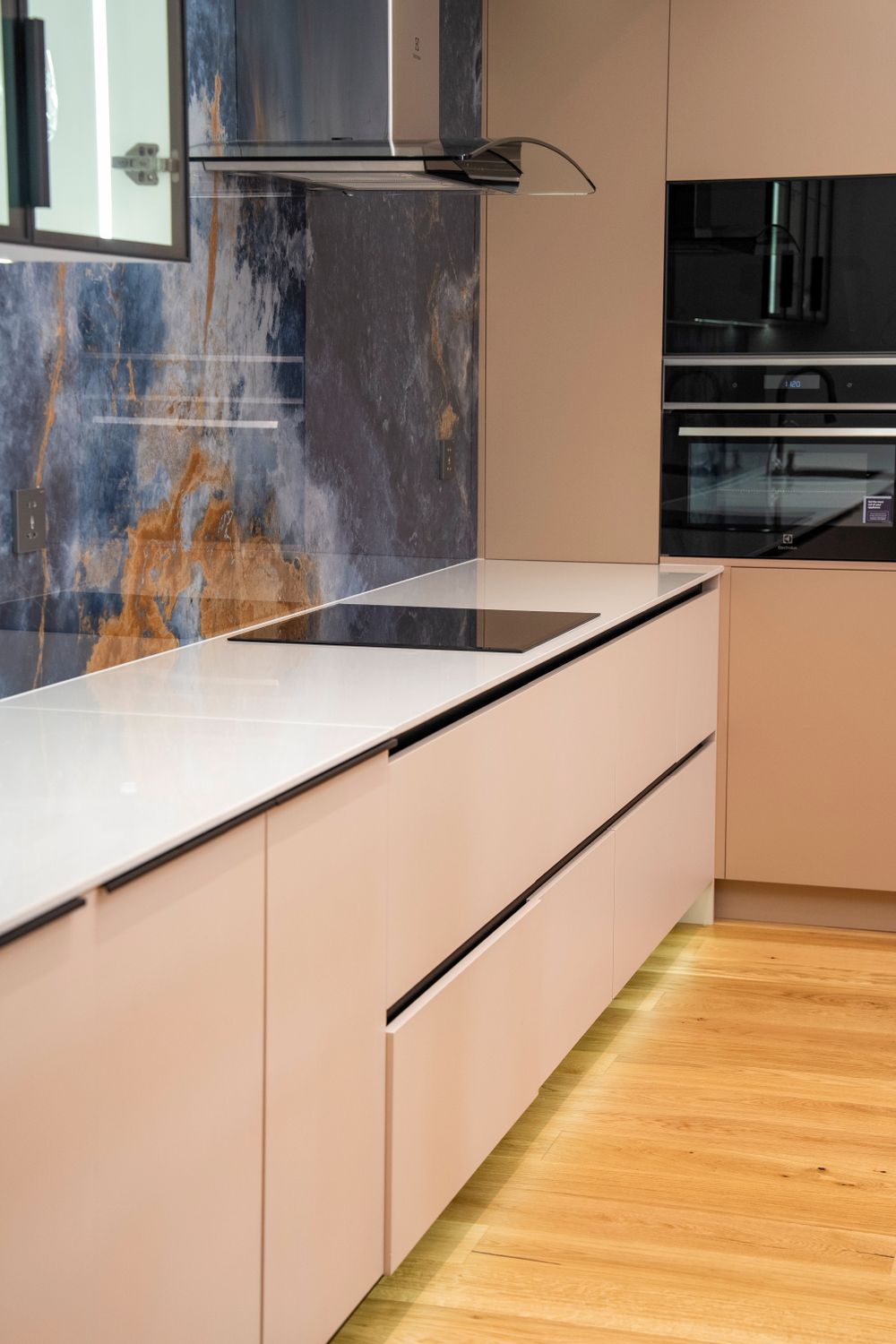
Engineered quartz typically arrives at around 3050 × 1440 mm in 20 or 30 mm. Sintered stone comes in up to 3200 × 1600 mm in 6, 12 and 20 mm.
That extra sheet size matters more than it sounds. It is the difference between a 3.1 m island with a joint and a 3.1 m island without one. In 6 mm, sintered stone also clads a full-height shower wall or wraps a cabinet door, which quartz cannot do.
For a worktop look in 12 mm sintered stone, we mitre a 12 mm sheet into a 40 mm apparent edge. Done properly the joint is invisible; done badly it is the first thing you see. This is entirely a fabrication question.
Fabrication risk
Quartz is forgiving. Standard diamond tooling, well-understood cut-out radii, and a chip is usually repairable with colour-matched resin.
Sintered stone is not forgiving. It needs continuous-rim blades, slow feed rates, water cooling and generous internal radii at every cut-out. Rushing a sink aperture cracks the sheet, and a cracked sheet is scrap. This is the main reason fabricators vary so widely in how they handle it — some have genuinely mastered the skill, and some are learning on your slab.
What to ask a fabricator
- How many sintered stone kitchens have you completed?
- What internal radius do you use at sink and hob cut-outs?
- Do you dry-assemble mitred edges in the workshop before delivery?
- Who carries the cost if a sheet cracks during fabrication?
Where each one wins
Sintered stone carries a fabrication premium over engineered quartz — it needs specific tooling and an experienced cutter — but the gap has narrowed as more UAE workshops invest in the right equipment.
Choose engineered quartz for indoor kitchens and bathrooms where budget matters, for multi-unit developments where colour consistency across many slabs is essential, and where the fabricator is an unknown quantity.
Choose sintered stone for outdoor kitchens and sun-exposed counters, for very large islands where a joint would be visible, for full-height shower walls, and for households where hot pans genuinely land on the worktop.
And if you want the honest third answer: for a busy indoor family kitchen with a moderate budget, a good granite still outperforms both on value. It is just not what the mood board says.